Want this built around your puppy’s age and your own wake-up time? Use the free puppy schedule builder to get a printable version, then adjust it using the guidance below.
A puppy daily routine should make the next useful choice easier: rest before overtired behavior, a bathroom opportunity before an accident, and a short learning session before frustration builds. Treat the routine as a flexible pattern rather than a timetable that every puppy must follow.
Start with a repeatable cycle
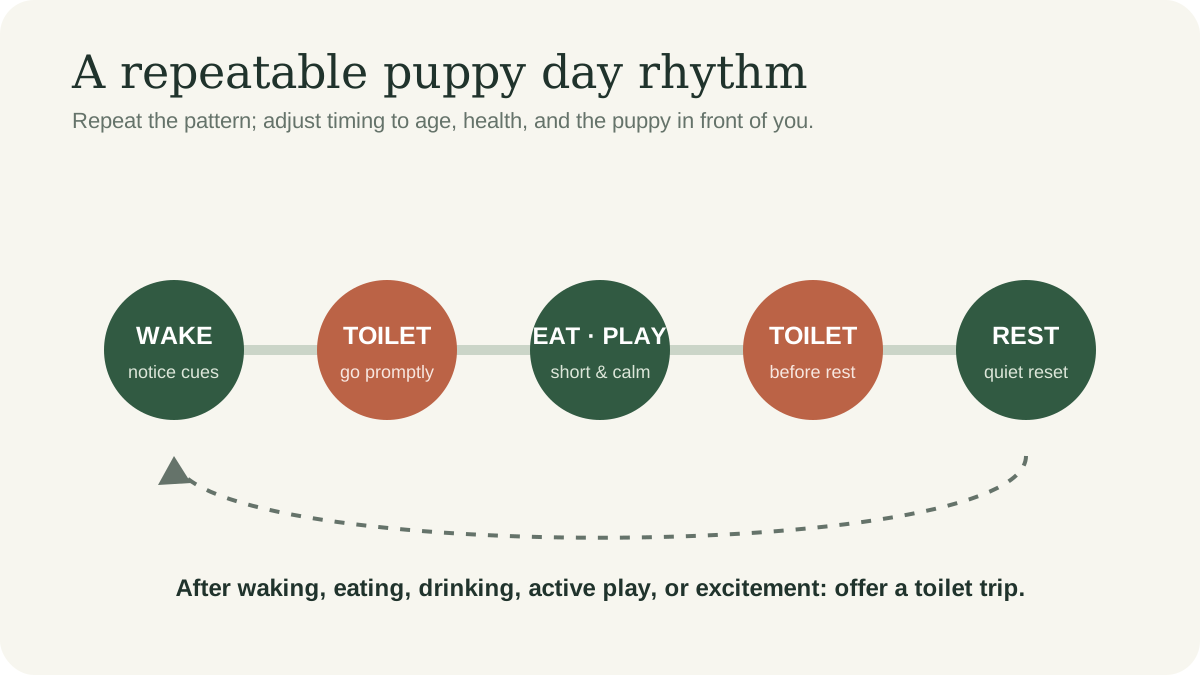
Most of the day can be built from one simple pattern:
Wake → toilet opportunity → food, play, or learning → toilet opportunity → protected rest
Repeat the cycle according to the puppy in front of you. A very young puppy generally needs more supervision, more frequent toilet opportunities, and more sleep than an older puppy. Illness, travel, a growth change, hot weather, or an unusually busy day may temporarily change the pattern.
Build the day from anchors
Choose a few events that happen in roughly the same order:
- Wake up and go to the toilet area.
- Offer food and water according to the plan from the puppy’s caregiver and veterinarian.
- Give a little calm movement, play, or exploration.
- Practice one easy skill for a few minutes.
- Offer a quiet nap in a safe resting space.
- Repeat the cycle, with more toilet chances after sleep, eating, drinking, and active play.
The exact clock time matters less than observing your puppy and repeating a predictable sequence. Toilet opportunities are especially useful after waking, meals, drinking, active play, excitement, and before and after an absence. Keep a simple note for a few days so you can see patterns in sleep, appetite, bathroom needs, and energy.
Sample routine for an 8-to-12-week-old puppy
This is a sequence to adapt, not a promise that a puppy can wait until the next listed time.
| Part of day | Flexible plan |
|---|---|
| On waking | Go directly to the toilet area; reward success immediately |
| Early morning | Meal according to the existing feeding plan, brief interaction, another toilet chance |
| After activity | Quiet nap in a safe resting area |
| Late morning | Toilet, gentle exploration, two or three minutes of learning, rest |
| Midday | Meal if included in the puppy’s feeding plan, toilet, calm activity, nap |
| Afternoon | Repeat short wake-and-rest cycles; include a positive new experience without overwhelming the puppy |
| Evening | Meal plan, toilet, calm family time, brief play or training, protected rest |
| Bedtime | Quiet toilet trip and a predictable sleep setup |
| Overnight | Respond to the individual puppy’s bathroom and comfort needs without turning the trip into playtime |
Young puppies cannot be expected to follow an adult workday. Arrange supervision and toilet support instead of testing how long they can wait.
Sample routine for a 3-to-4-month-old puppy
The same cycle remains useful, but some waking periods may become longer and the puppy may manage slightly more learning and exploration. Keep naps protected and continue toilet trips around transitions.
- Morning: toilet, meal, brief movement and training, toilet, rest
- Mid-morning: toilet, sniffing or a calm social experience, rest
- Midday: meal if still part of the feeding plan, toilet, handling or grooming practice, rest
- Afternoon: toilet, short independent activity, play or training, rest
- Evening: meal plan, low-pressure walk or exploration, toilet, calm household time
- Bedtime: familiar wind-down sequence and final toilet trip
At four months, progress is not linear. Teething, growth, vaccination appointments, schedule changes, and stimulating outings can temporarily increase sleep or reduce concentration.
Sample routine for a 5-to-6-month-old puppy
An older puppy may be ready for longer walks appropriate to their health, more varied training, and gradually longer calm periods. Adolescence can also bring distraction and inconsistent responses.
Keep the structure rather than removing it: regular meals, toilet opportunities, planned rest, appropriate movement, short learning sessions, and gradual independent time. Increase only one difficulty at a time—duration, distance, distraction, or independence—so you can see what the puppy can actually manage.
Protect sleep
Young puppies need frequent rest. A puppy who becomes frantic, mouthy, unable to settle, or suddenly forgets an easy skill may be tired or overstimulated rather than stubborn. Lower the noise, guide them to a safe resting area, and keep the next activity simple.
A crate, pen, or gated room can help when introduced gradually as a comfortable place. It should not be used as punishment or as a way to leave a puppy for longer than they can manage. Plan bathroom breaks and supervision around the puppy’s age, health, and previous routine.
Use the puppy sleep schedule if evenings become increasingly frantic or naps keep disappearing.
Keep learning short and useful
Choose one behavior at a time: looking at you, following a hand, settling on a mat, trading a toy, or walking through a doorway. Reward the behavior quickly, then stop while the puppy is still able to succeed. Several tiny sessions are often easier than one long lesson.
Add everyday learning to the routine. Touch a collar gently, hear a quiet household sound, step onto a different surface, or settle while you move a few steps away. Pair new experiences with food, play, or rest, and back up if the puppy shows worry.
Socialization is not a requirement to greet everything. Let the puppy notice people, sounds, surfaces, animals, handling, and travel at an intensity where they can remain comfortable. Ask the veterinary team how to balance safe exposure with local disease risk and vaccination status.
Plan alone time gradually
Puppies should have safe opportunities to play independently and rest away from you. Start with seconds or a few minutes while the puppy is calm, then return before distress builds. A chew or food toy can help if it is safe for that puppy and supervised at first.
Do not use a routine to ignore panic. If a puppy vocalizes intensely, tries to escape, injures themselves, or cannot settle when separated, record what happens if safe and contact your veterinarian or a qualified behavior professional.
Building a routine around work
A full workday is not a suitable first independence exercise for a young puppy. Before the schedule changes:
- List when the puppy normally wakes, toilets, eats, plays, and sleeps.
- Identify which needs will occur while everyone is away.
- Arrange a family member, trusted sitter, walker, or other appropriate care.
- Practice short calm absences separately from the longest necessary absence.
- Use a safe area the puppy already knows; do not introduce confinement for the first time as you leave.
- Check the puppy’s response through direct observation or a recording when safe and lawful.
If the puppy cannot eat, settle, or recover during brief absences, get help before increasing the duration.
Adjust the plan every week
As your puppy grows, their sleep, bathroom, exercise, and enrichment needs change. Keep the anchors that help and change the spacing around them. A good routine gives the puppy enough rest, regular chances to succeed, and room for ordinary life rather than filling every hour with training.
Track patterns without turning the day into a spreadsheet
For three to five days, note only the details that affect decisions:
- Wake and sleep periods
- Meals and major treats
- Successful toilet trips and accidents
- High-energy or biting periods
- Time alone and whether the puppy settled
- New experiences and recovery afterward
Look for sequences. An accident shortly after play suggests a missed toilet opportunity. Evening biting after a busy afternoon may point to lost rest. Distress that begins immediately when a person leaves is not solved by making the puppy more tired.
Frequently asked questions
How strict should a puppy schedule be?
Keep the order predictable but let timing respond to the puppy. A rigid clock can miss a bathroom need, fatigue, fear, or illness.
How much training belongs in the routine?
Use several very short sessions and stop while the puppy remains successful. Everyday moments—following you, waiting at a door, settling, trading, and accepting gentle handling—can do much of the work.
What if the puppy will not nap?
Check toileting, hunger, temperature, discomfort, noise, and recent activity. Reduce stimulation and repeat a familiar wind-down routine. Persistent restlessness or a sudden change deserves veterinary advice.
When should the routine change?
Adjust it when the puppy consistently manages the current pattern, not merely because another puppy of the same age follows a different timetable. Change one part, observe for several days, and keep the anchors that still help.
Editorial source check
Sources and scope checked by Dogward Editorial
Checked . This confirms the source record and editorial boundaries; it is not a claim of veterinary, clinical, or credentialed behavior review.
Sources & further reading
Use these references to explore the topic in more depth. Links open the original publisher’s site. See how Dogward selects and checks sources.
- Preventive Behavioral Care: Setting your Pup Up for SuccessAmerican Veterinary Society of Animal Behavior
- General Dog CareASPCA
- How to Toilet Train Your Puppy or DogRSPCA
- Caring for Your Puppy: 6 Weeks to 12 MonthsRSPCA